Prologue
How it started
The first pitch came at 12:14 AM Eastern time on Friday, November 13.
The first idea, for the 2026 Epic AI MegaJam, was a lord who sends the village off to fight over an insult at a banquet. The game was inspired by Stronghold and Chivalry. The village runs its own economy, and monks win soldiers over to your side. The troops manage themselves, so the player runs the village and the castle, not the battles. When the player is overwhelmed, the fight drops into first person, hand to hand. The game was first called No M’Lord: Peasant Uprising and became Peasant Revolt on Saturday.
The muster
At the Ferret’s fort, a peasant knocks the Ferret out with a pitchfork. The Ferret was first called the Rat, and then the Mouse.
Mission one
Not a big army. Build the economy, keep the people happy and recruit monks. Enough monks, and the attacking soldiers switch sides.
The warning
Cutscenes come first, and every one is a must-have. Mechanics come before beautiful gameplay visuals.
Each of these was written into the project record the same day.
Act I
How the work was run
I produced it with a crew of AI coding agents, and the jam version came together over one weekend.
Each agent worked on its own branch and merged into the main branch when its work was done. The changelog records which changes were compiled or tested, and which were not.
Each dot is a commit, and each ring is a merge. The shaded stretches are when I was asleep. Commits by GPT-6 Luna ran on their own, almost all of them overnight.
Every commit in the tree, counted by the model that signed it. Merges are not counted here.
The work was split across the models, and the chart shows what each one did. The record names the model for most commits; the chart counts the rest as not named.
Rules that kept it honest
- One handbook that every agent follows.
- My instructions, written into the project record the same day.
- Every decision marked Confirmed, Proposed or Open.
- Every change signed with the model that wrote it, where the commit names one.
- “Tested” and “Unverified” kept apart.
- I play every build. The agents do not mark their own work.
Three rules for parallel work
- One worktree per Claude session: each session has its own copy of the project, on its own branch.
- Two writers avoid sharing a file.
- Merge up when done: finished work goes into the main branch and is pushed.
Act II
What we built, and what we did not
The jam chapter runs from waking in the hut to choosing a place on the map. The table shows what is built, and what is not.
| System | What it does | Status |
|---|---|---|
| Settlement economy | One service owns every stock count. Each change goes through one all-or-nothing transaction, so stock never goes negative. | Built |
| Production chains | Brewing, farming and food each climb from plain to rich. | Built |
| Livestock | Chickens and sheep are kept, and old animals can turn to meat. Laying keeps a hen alive. | Built |
| Popularity and chicken sacrifice | Popularity rises and falls with things like taxes and drink. Sacrificing a chicken buys a timed boost. | Built |
| Taxes, priorities and recruiting | Tax levels from none to cruel. Production priority and recruiting are settings that stay in force until changed. | Built |
| Recruit-taught technology | Recruits teach wood, stone and iron working over time, and the knowledge stays. | Built |
| Monks and priests | Monks hand soldiers beer from the settlement’s own stock. Each rank persuades harder, and nearby allies of the same lord make a man harder to turn. | Built |
| Bishops and the cathedral | Defined in the data, but not buildable yet. | Designed, not built |
| Defection | Winning a soldier over switches him to your side in one step. | In the chapter |
| Beer as a weapon | Kegs are carried, thrown so they splash, or left as a lure that soldiers drink from until they turn. | In the chapter |
| First-person melee | Slash, stab, block, counter and parry, close up. | In the chapter |
| The Ferret’s map | The countryside map, and a board for choosing where the revolt goes next. | In the chapter |
| Self-managing troops | Fighters go at nearby enemies by themselves, monks go to persuade, and everyone comes home. | Built |
| Calling out the lord | The peasant calls out the lord to a duel. Winning takes the place. | Built |
| Looted weapons | A better weapon is taken from each place, up from the pitchfork. | Built |
| Keg catapult | Lobs kegs into enemy ranks. Off until its places are laid out for the new village map. | Switched off |
| Tower archers and the Doberman rider | Archers man the towers by themselves. They are off until their places are laid out for the new village map. A rider on a Doberman is also in the code, off for the jam chapter at my request. | Switched off |
Few rules, checked in code
The most important rules are also checked in code.
The design keeps a small set of rules. The main one is the rule of three: things come in threes, to keep the game simple. An audit listed the places where the game broke the rule of three and suggested a fix for each. Some have since been fixed. The rest are still open.
How a place falls
Show how a place falls
- A crowd at the gate: enough peasants hold at the gate and it gets opened. Ordinary places can also be taken by a small party of keg-carrying monks, who open the gate.
- Duel one on one: the peasant calls out the lord and beats him.
- Duel three a side: three fight on each side, and winning takes the place.
- Duel six a side: six fight on each side, and winning takes the place.
A place falls in one of these ways, and never in one big battle. Which way, and at what duel size, is set for each place and lord in the game’s data.
Act III
Decisions
What was cut or changed, and why.
| The call | What was cut or changed | Why |
|---|---|---|
| The knockout clip | Rejected outright. The knockout stays in the game as a scene, and how it is staged is still open. | It looked like concept art, not the game. |
| Toy art | Free low-poly toy kits banned. Bought village and foliage packs used instead, and a stylized bought castle pack for the buildings. Some props still have no owned replacement, and the hens still have a toy look. | Use what the project already owns before making anything new. |
| One map and one skeleton | Scenes now share one village map. Bodies now share one skeleton. | The map was measured once and kept as data, so nobody has to reopen it. With one skeleton, every bought animation plays on everyone. |
| Localization | Built, then paused on November 15 because it was slowing the opening work. | English only until I do one translation pass at the end. |
| Switched off, not deleted | The keg catapult and the tower archers stay in the code, switched off in the data. The Doberman rider stays in the code, off for the jam chapter. | The catapult and the archers come back on once their places are laid out for the new map. The rider is left out of the jam chapter, at my request. |
Character art
From drawing to rig
The original character sheets, a generated model, and the work between them.
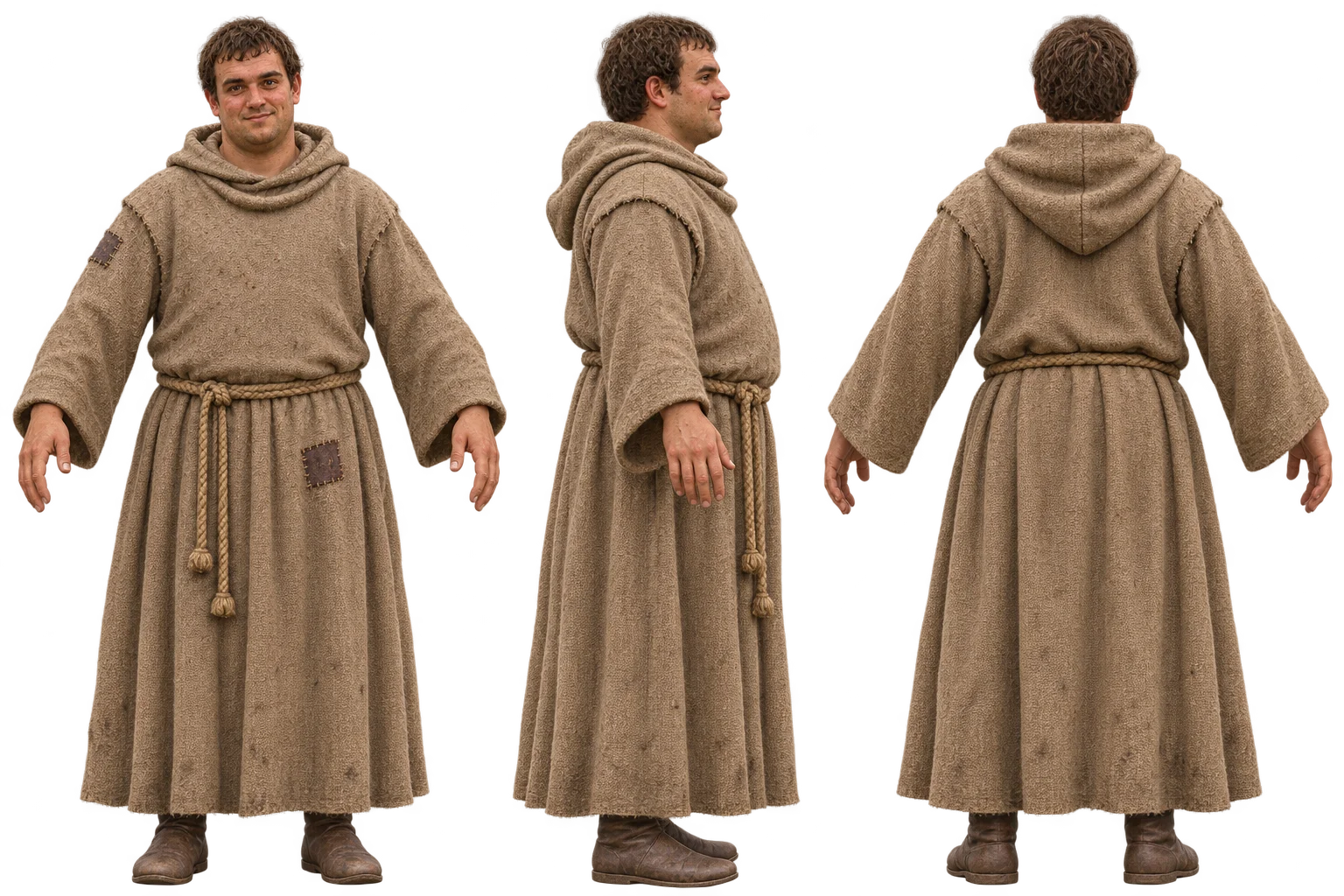
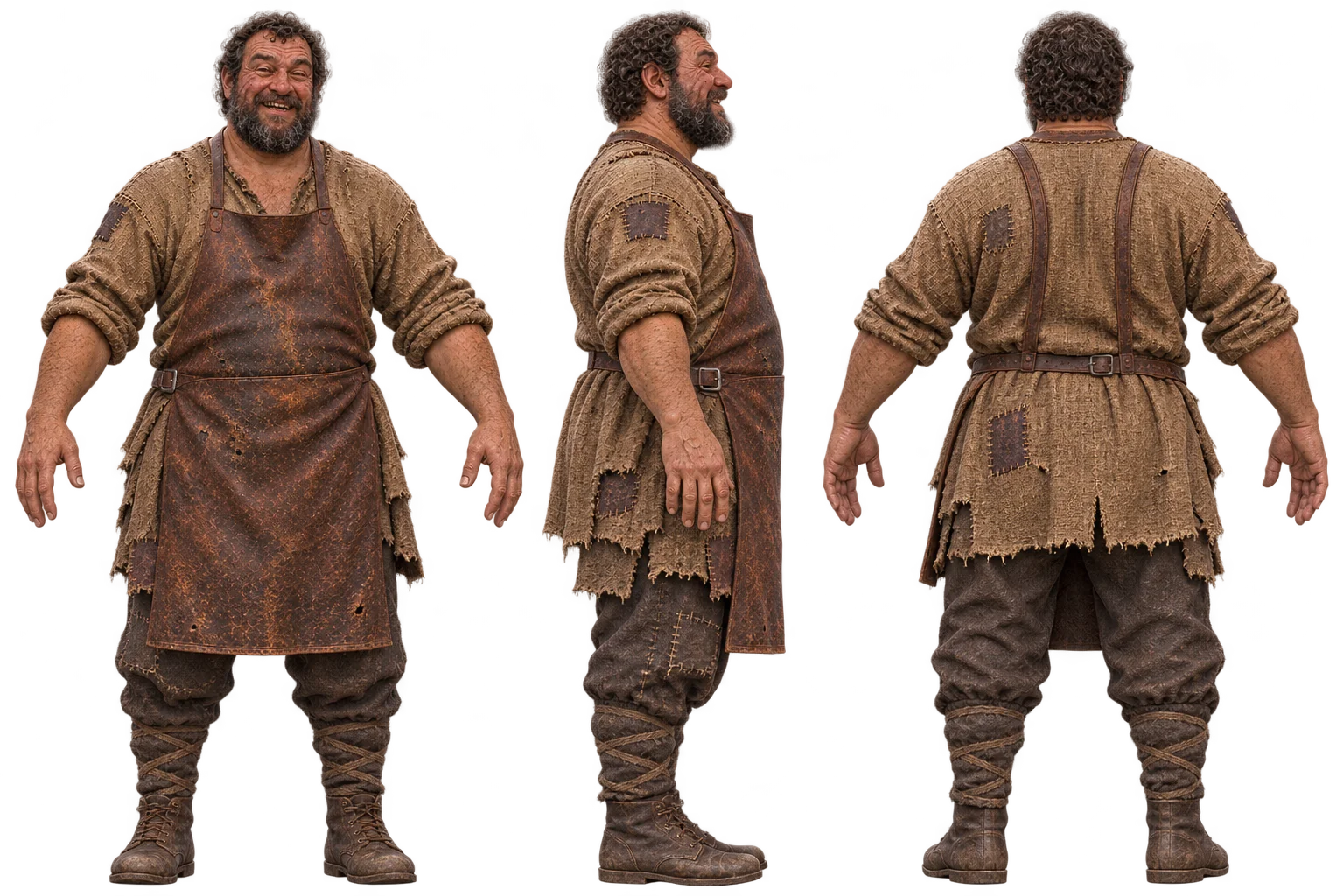
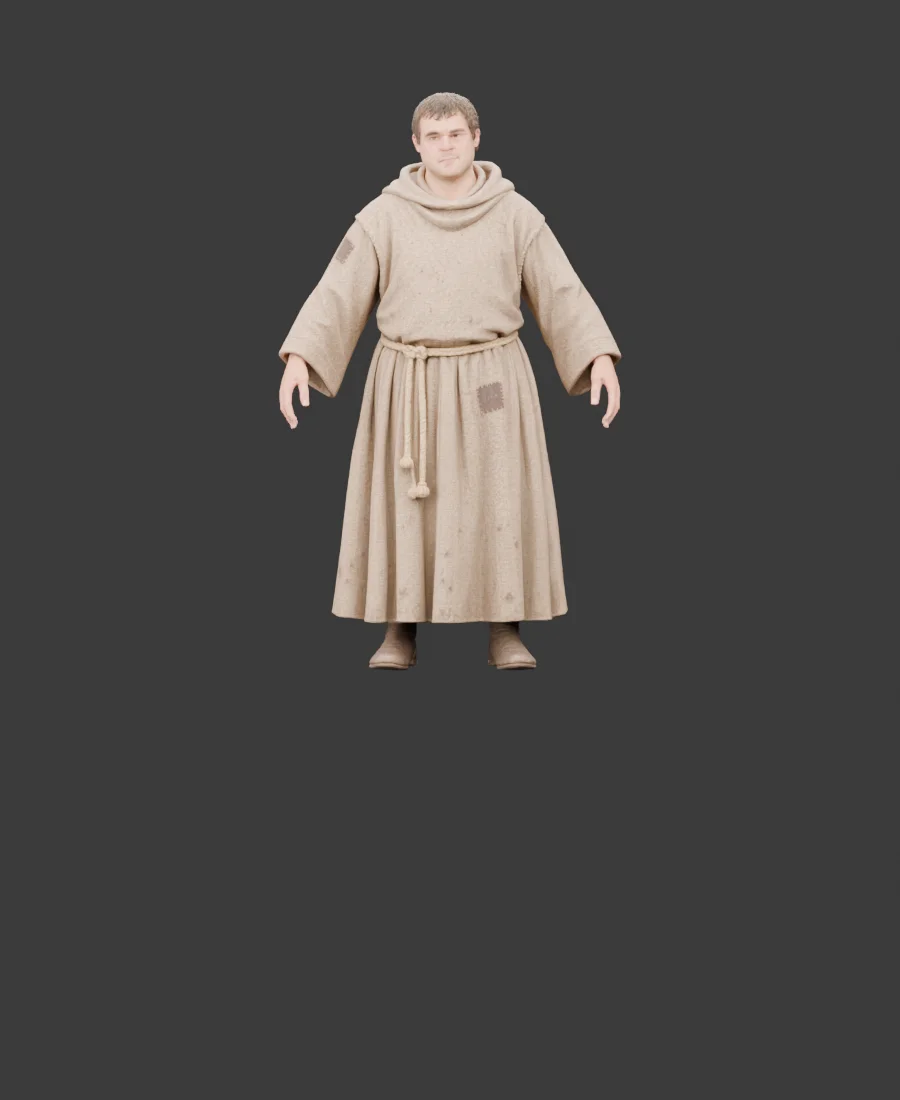
I started with character portraits. Codex’s built-in image generator made matching full-body front, side and back views, with the same clothes and proportions, visible hands and feet, and even lighting. These are relaxed A-poses, with the arms angled down, rather than straight-arm T-poses. The pictures are modeling references, not skeletons or animation-ready characters.
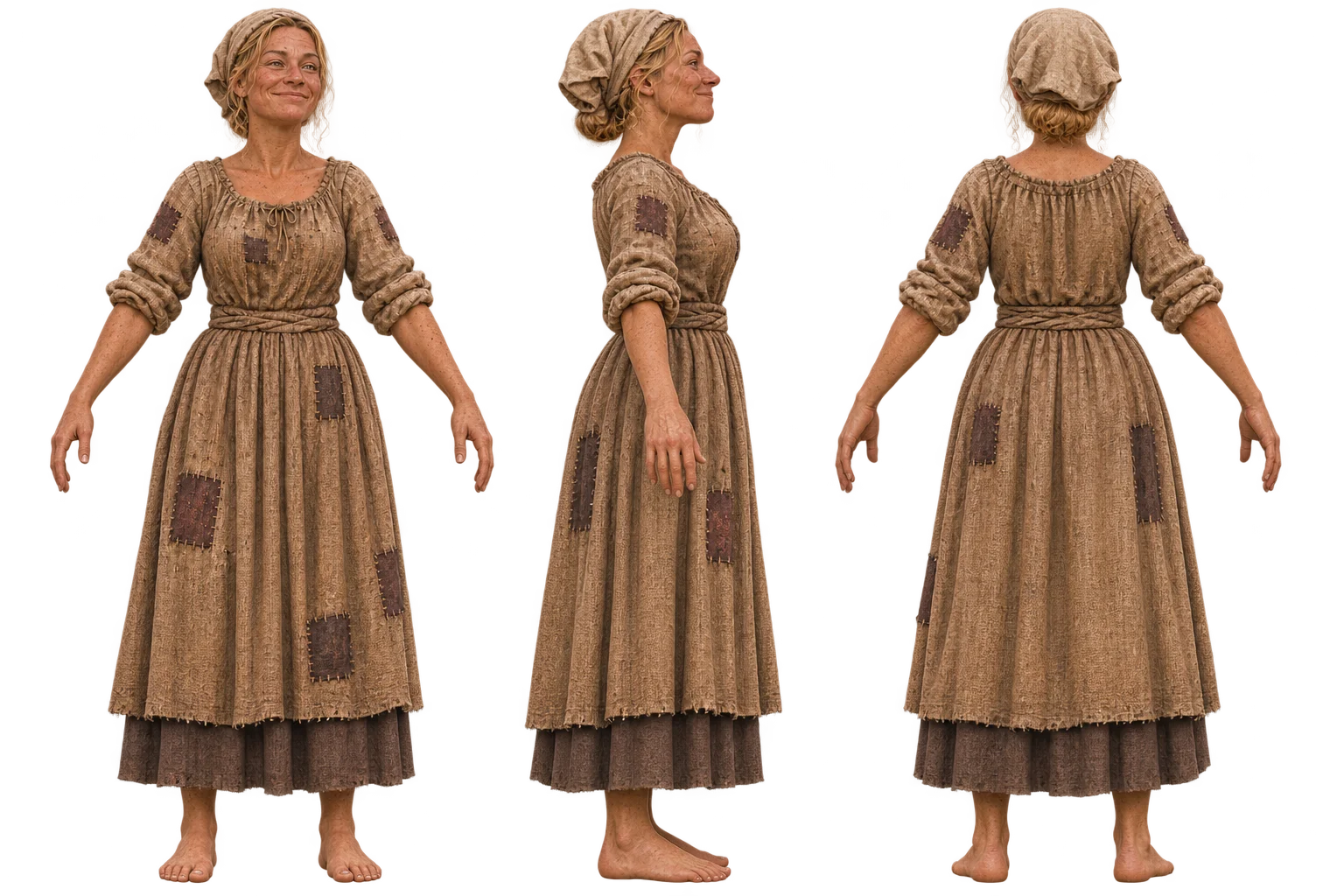
What went through FAL
- Separate the views. We cropped the front, side and back out of the reference sheet, so the model-making service received each view as its own image.
- Make the body. Meshy’s multi-image-to-3D service through FAL turned those views into a textured mesh. This step made the character’s surface and shape, without automatic rigging.
- Add the skeleton. A separate Meshy rigging job through FAL used the generated model, with its Unreal mannequin template and fingers enabled. It returned rigged GLB and FBX files. The reference pictures themselves did not contain a rig.
That was not the last step. FAL’s Unreal mannequin rig was not identical to the skeleton used by the bought Combat Master animation pack. We later rebuilt the bodies onto the game’s actual shared skeleton so those animations could play on them. Making the model and making it work with the game’s animation system were separate jobs.
These are saved production images from the original character workflow, not newly generated examples. Select any image to see it larger.
Now
Since the jam
The jam build shipped before the deadline on November 15. Since then the game has kept changing, in these ways.
Windows only now
The jam build came from a Mac. The game is now built, packaged and played on Windows only.
One animation system
Every person now stands on one skeleton and plays the bought Combat Master moves. The older character pack and its animations are out.
A busier village
Dogs roam the whole village instead of bunching together. Soldiers carry different weapons, and there are more soldiers in the opening and the raids.
The trailer
Re-cut after my review. The current cut opens on Florian himself.
Still open: how the game plays and feels. I judge that by playing each build. The keg catapult and the tower archers wait for their places on the new village map. The bishop and the cathedral are designed but cannot be built yet. Localization is parked until I do one full language pass at the end.
Download version 0.2.2 for Windows
Version 0.2.2 is a work-in-progress Windows test build, 919 MB. Several of its changes have not been played yet, and some may break things. The jam build was the first, rougher pass; this one replaces it.
The other work: ARC-AGI-3
ARC-AGI-3 is a public contest where AI systems must learn games they have never seen, with no instructions, by playing them. It is hard for AI because nothing explains the rules, so the system has to explore and test ideas by playing.
Team Turducken finished 5th of 4,923 teams on the final public leaderboard. My role was producer and one of the game makers. The harness, the inference and the reinforcement learning were my teammates’ work. Son Pham led the team and did the harness and inference engineering, with Slow∞Loop. Keith Tyser did the reinforcement learning, and Ronen Dunlea, NT and ngyzly made games alongside me.
Read the team’s write-up. You can play the synthetic games: candidate games were played and reviewed, and only the ones that passed were kept. The ARC Explainer is at arc.markbarney.net.